Research Highlight: Cambrian Fossil Treasure Reveals True Origin of Bryozoans
Exceptionally preserved 520‑million‑year‑old fossils from southern China have finally resolved the evolutionary origins of bryozoans, the only major animal phylum that seemed to have mysteriously escaped the Cambrian explosion.
Discovered in the Xiannudong Formation, the fossils include Protomelission gatehousei and a new species, Dayingomelission hexaclitia. Their delicate modular skeletons still contain phosphatized soft tissues: membranous sacs, annular and longitudinal muscles, ring septa, and distinctive styles. These features are uniquely diagnostic of bryozoans — colonial filter‑feeders also known as “moss animals.”
“These fossils are a game‑changer,” said lead author Zhifei Zhang of Northwest University, China. “For the first time, we see the soft‑body anatomy of Cambrian bryozoans, which leaves no doubt about their identity.”
Previous molecular clocks had long suggested bryozoans originated in the Cambrian, but the fossil record stubbornly began only in the Ordovician, a puzzling gap. Some even argued that Protomelission was a green alga or a sclerite of another animal. The new specimens, with their in‑situ soft tissues and hexagonal box‑shaped zooids, refute those interpretations.
Phylogenetic analysis places both fossils firmly within the crown group Stenolaemata, meaning bryozoans were already diversifying during the Cambrian radiation. The discovery also pushes the origin of their stem lineage back into the Ediacaran.
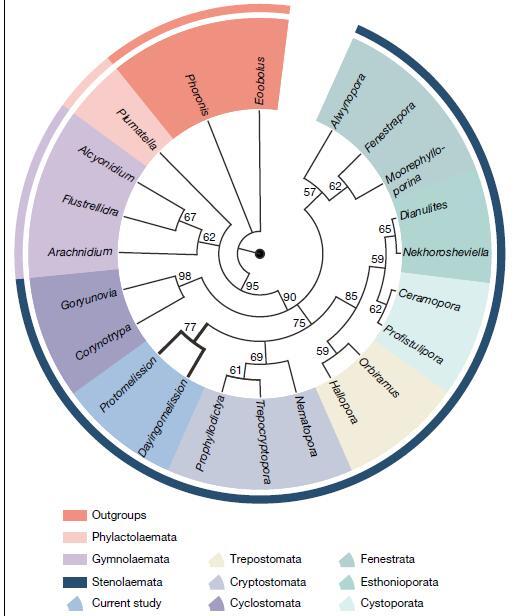
“This confirms that bryozoans are true Cambrian animals, just like trilobites and brachiopods,” said co‑author Luke Strotz. “The Cambrian explosion was even more complete than we thought.”
The study appears in Nature.
——
Reference
Song, B., Zhang, Z., Strotz, L.C. et al. High-fidelity modular skeletons authenticate a Cambrian origin for Bryozoa. Nature (2026). https://doi.org/10.1038/s41586-026-10590-9
File Download: