A recently published study in Nature reports the discovery of a remarkably preserved Middle Jurassic fossil that blurs the early evolutionary line between lizards and snakes.
The fossil, named Breugnathair elgolensis, comes from rocks about 167 million years old on the Isle of Skye, Scotland. It belongs to a previously little-known group called parviraptorids, which have been suspected to play a role in snake origins.
What makes B. elgolensis especially surprising is its “mosaic anatomy” — a mixture of traits that in living reptiles appear separately in lizards or snakes. For example:
- It has a lizard-like body shape with well-developed limbs, and proportions somewhat like monitor lizards.
- Its teeth and jaws show snake-like features: recurved (hooked) teeth and dental structures reminiscent of snakes.
- At the same time, it retains primitive traits seen in early lizard lineages, such as unfused skull bones and certain features of the palate.
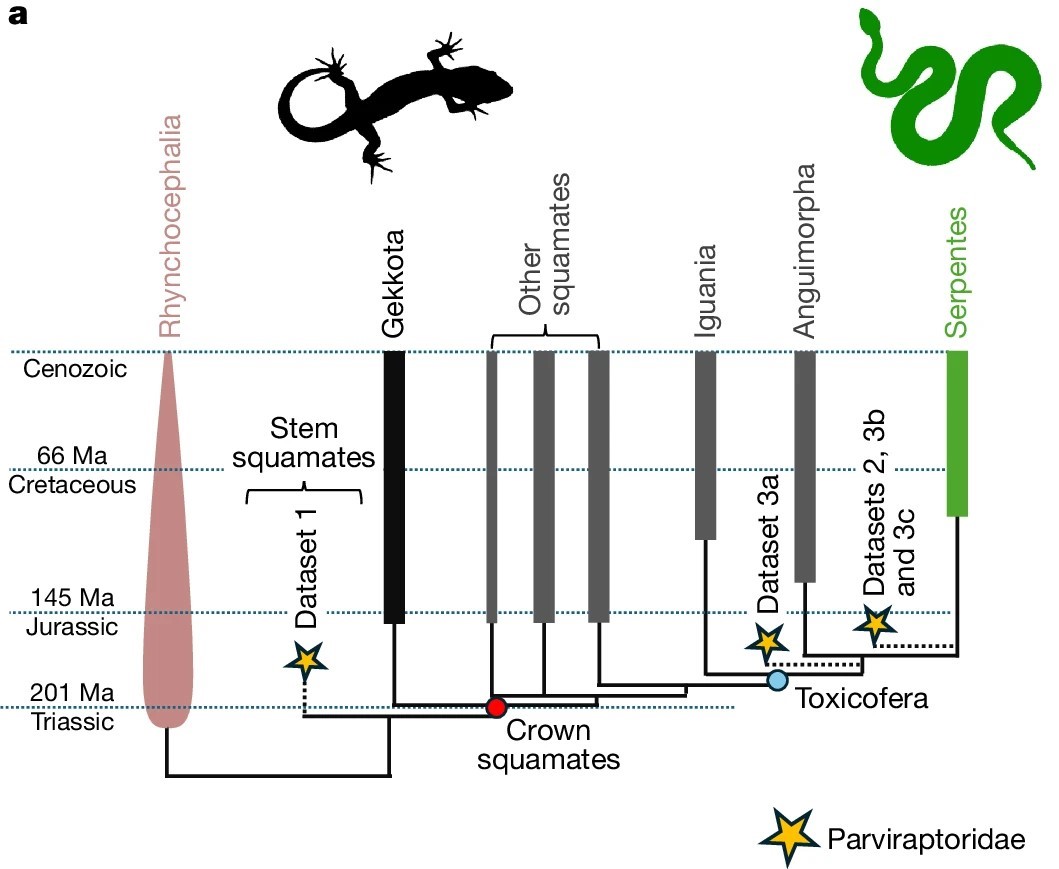
Fig. Summary of phylogenetic results
Because of this mosaic mix, scientists ran several evolutionary “phylogenetic” analyses. Some results favor placing parviraptorids on the early branch of snakes; others suggest they lie outside the snake lineage as stem squamates (early lizard + snake ancestors).
In short, B. elgolensis demonstrates that during the deep history of reptiles, evolutionary experimentation was common. Certain snake-like traits may have evolved more than once (convergent evolution), and the path from lizards toward snakes was not linear or simple.
This fossil helps fill a significant gap in our understanding of how today’s lizards and snakes—the squamates—diversified during the Jurassic era. Future fossil discoveries and high-resolution imaging may further untangle the branching tree of reptile evolution.
Reference
Benson, R.B.J., Walsh, S.A., Griffiths, E.F. et al. Mosaic anatomy in an early fossil squamate. Nature (2025). https://doi.org/10.1038/s41586-025-09566-y
File Download: