Research Highlight - Ancient Spiny Creature Fills Gap in Evolution of Starfish and Sea Urchins
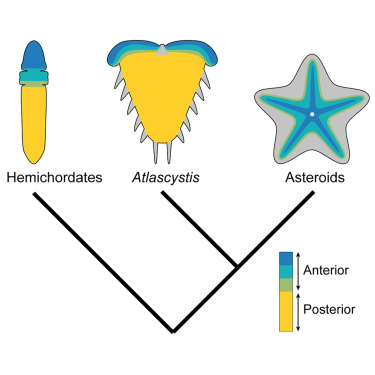
A remarkable 500 million year old fossil discovered in Morocco is reshaping our understanding of how starfish and sea urchins evolved their unique five-pointed body plans. The new species, Atlascystis acantha, is the oldest known bilaterally symmetrical echinoderm, the group that includes modern echinoderms like sea stars and sea urchins, which are famous for their radial symmetry.
Unlike its modern relatives, Atlascystis ad a flattened,spiny,triangular body with two long rear spines and a pair of feeding structures called ambulacra, the earliest evidence of the water vascular system that defines echinoderms today. By studying growth patterns in its calcite plates,researchers showed that these structures developed in the same way as the arms of living starfish.
Phylogenetic analysis confirms that Atlascystis sits on the ancestral stem of the echinoderm family tree, bridging the gap between bilateral ancestors and later radially symmetric forms. This suggests that echinoderms gradually evolved their distinctive five-part body plan through a series of morphological and developmental changes, including the loss of trunk identity and duplication of growth zones.
The study, published in Current Biology, highlights the critical role of fossils in deciphering one of the most dramatic evolutionary transformations in animal history.
______
Reference:
Stephanie C. Woodgate,Frances S. Dunn,Jeffrey R. Thompson,Laurent Formery,Samuel Zamora,Imran A. Rahman. A new Cambrian stem-group echinoderm reveals the evolution of the anteroposterior axis. Current Biology,Volume 35,Issue 14,2025,Pages 3488-3495.e3,https://doi.org/10.1016/j.cub.2025.05.065.
File Download: